


What does an FTA do?
A Free Trade Agreement (FTA) is an agreement under which the countries that have signed it provide each other with exclusive trade benefits by abolishing tariffs and other barriers to trade in goods and services between the countries. Free Trade Agreements (FTAs) have so far gone into force largely between neighboring countries or in certain regions, just as in the cases of the European Union and the North American Free Trade Agreement (NAFTA). Thus, an FTA is often referred to as a Regional Trade Agreement (RTA).
A regional trade agreement can be divided into four phases depending on the degree of economic integration among the signatory countries.
-
01Free Trade Agreement
-
02Customs Union
-
03Common Market
-
04Complete Economic Union
Types and comprehensive scope of Free Trade Agreements
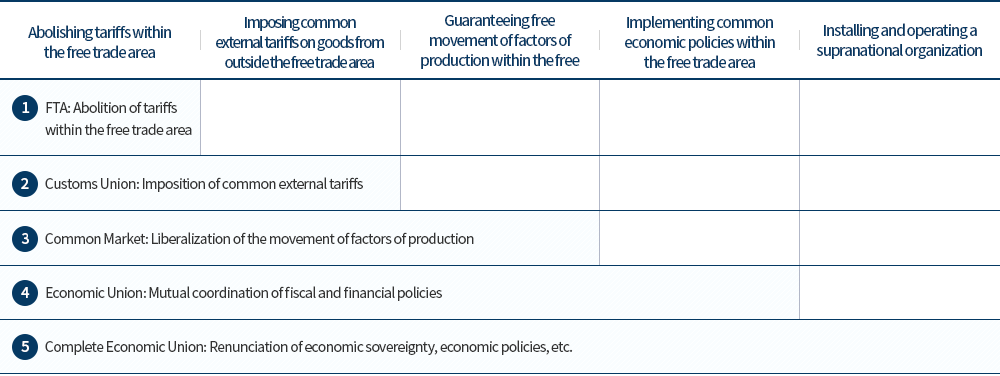
Free Trade Agreement (FTA)
Various types of trade restriction measures including tariffs are abolished for free trade among member countries (for example, NAFTA).
Customs Union
The member countries take joint steps by applying a common external tariff to non-member countries in addition to free trade among the member countries (for example, MERCOSUR).
Common Market
Besides the customs union-level trade policy, the free movement of factors of production, such as labor and capital, is allowed among the member countries (for example, EC, CACM).
Economic Union
The member countries implement common policies among them by mutually coordinating all the economic policies including fiscal, financial and social welfare policies.
Complete Economic Union
The member countries withdraw their independent economic policies, integrate and operate all the economic policies, and set up a supranational organization, such as a single parliament, among them.
콘텐츠 만족도 조사
페이지에서 제공하는 정보에 대하여 어느 정도 만족하셨습니까?